Menu
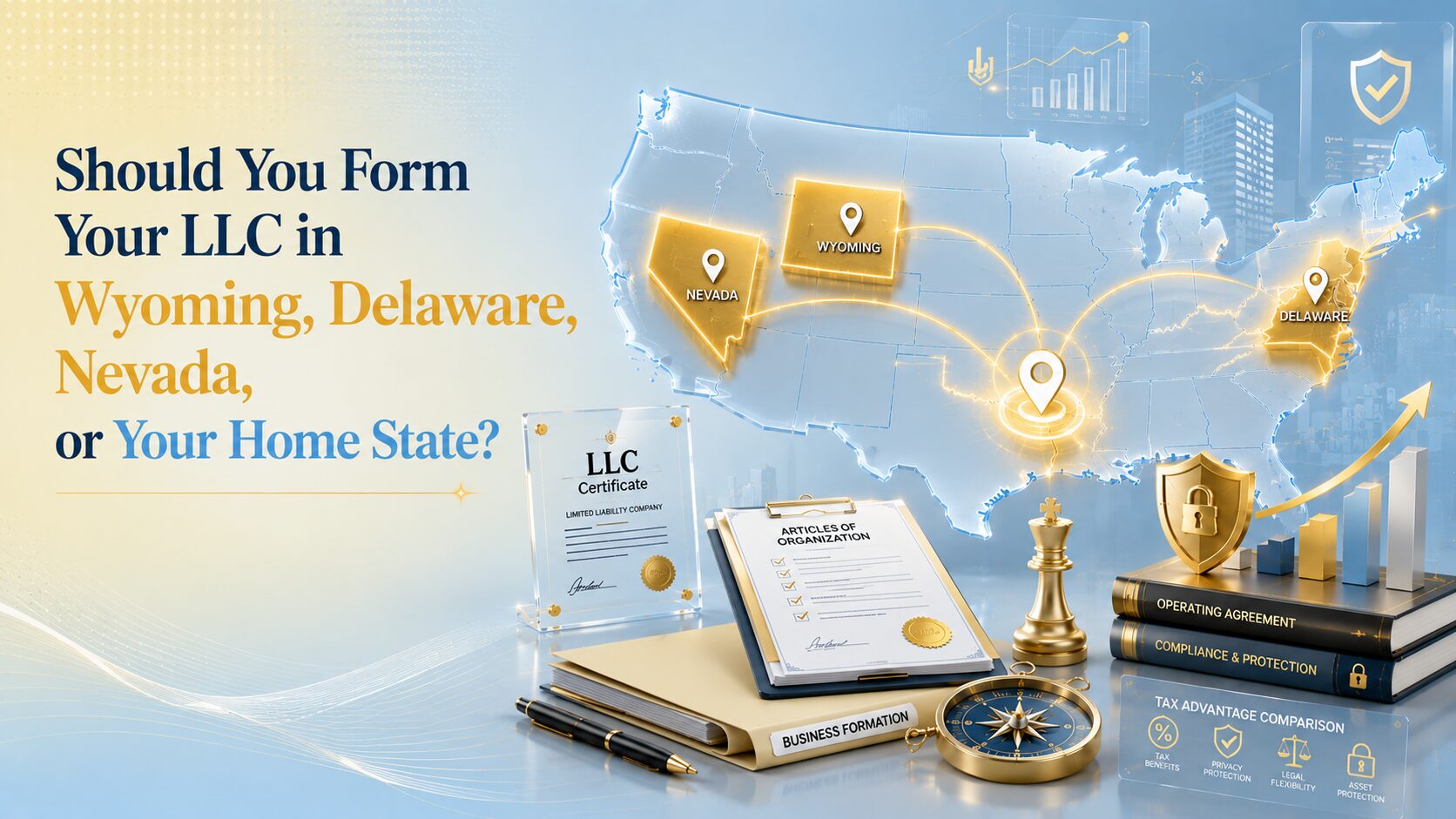
AI-generated Image
If you’ve spent any time researching LLC formation online, you’ve probably seen bold claims like:
While these statements contain some truth, they rarely tell the full story.
Choosing the wrong state can lead to unnecessary fees, duplicate filings, additional compliance requirements, and costly mistakes.
The reality is simple:
The best state for your LLC depends on where you operate, how your business generates income, and your long-term goals.
Before filing paperwork, it’s important to understand what actually matters.
One of the most common misconceptions among entrepreneurs is that forming an LLC in a tax-friendly state automatically eliminates state tax obligations.
Unfortunately, that’s usually not how it works.
In many cases, the state where you conduct business—not the state where you form your LLC—determines your filing and tax responsibilities.
Depending on your activities, you may still need to:
Simply forming an LLC in another state does not automatically remove these obligations.
The right formation state depends on more than tax rates.
Here are the key factors every entrepreneur should evaluate.
Some states limit the amount of ownership information that appears in public records.
If confidentiality is important, privacy laws may influence your decision.
LLC laws vary significantly from state to state.
Certain jurisdictions offer stronger protections against creditor claims, making asset protection an important consideration for investors and business owners.
Many entrepreneurs focus only on taxes.
A smarter approach is to evaluate the total ongoing cost of maintaining the entity, including:
The lowest-tax state is not always the lowest-cost option.
Think beyond today.
Ask yourself:
Your long-term strategy should influence your formation decision.
These three states consistently attract entrepreneurs, but each serves different business needs.
Wyoming has become a favorite among small business owners because it offers:
Wyoming is often attractive for holding companies, investment entities, and certain owner-managed businesses.
Delaware is known for its sophisticated business laws and highly respected court system.
It is commonly favored by:
Many investors prefer Delaware entities because they are familiar with Delaware’s legal framework.
Nevada attracts entrepreneurs because of its:
Depending on your business model, Nevada may offer advantages worth considering.
Many business owners assume that forming an LLC in another state eliminates their obligations at home.
Consider this example:
A consultant lives and works exclusively in New Jersey but forms a Wyoming LLC after hearing it offers tax advantages.
Because all business activities occur in New Jersey, the company may still need to:
In other words, the owner could end up dealing with compliance requirements in multiple states.
One of the most important concepts in state taxation is business nexus.
Nexus refers to the connection between your business and a state that creates legal, tax, or reporting obligations.
Nexus may be established through:
Understanding nexus is critical because it often determines where your company must register and file taxes.
In many situations, yes.
If you form an LLC in one state but actively operate in another, you may face additional obligations such as:
Failing to meet these requirements can result in penalties, late fees, and administrative headaches.
The Situation
A New Jersey-based consultant wanted to form a Wyoming LLC after hearing it would eliminate state taxes.
The Analysis
After reviewing the business structure, it became clear that all operations, clients, and services were located in New Jersey.
The Outcome
While Wyoming offered certain benefits, the business would still need to comply with New Jersey requirements.
By selecting a structure aligned with actual business operations, the owner avoided unnecessary costs and ongoing complexity.
The Lesson
The most popular LLC state is not always the best LLC state.
The right choice depends on where your business operates and where you plan to grow.
There are situations where forming outside your home state may provide meaningful benefits.
Examples include:
The key is making the decision based on facts—not internet myths.
Choosing where to form an LLC is more than a filing decision.
It’s a strategic decision that can affect taxes, compliance requirements, legal protections, and future growth opportunities.
Our team helps entrepreneurs evaluate:
We help business owners:
✔ Understand the true cost of formation
✔ Avoid common compliance mistakes
✔ Evaluate multi-state tax exposure
✔ Choose structures aligned with long-term goals
✔ Reduce administrative burdens
✔ Make informed decisions with confidence
Our goal is simple: help you build the right foundation from the start.
What is the best state to form an LLC?
There is no one-size-fits-all answer. The best state depends on your business activities, growth plans, tax considerations, and compliance requirements.
Is Wyoming better than Delaware?
Not necessarily. Wyoming is often attractive for privacy and asset protection, while Delaware is commonly preferred by startups seeking investment.
Can I avoid taxes by forming an LLC in another state?
Usually not. Tax obligations are often based on where your business activities occur and where nexus exists.
Do I still need to register in my home state?
If you conduct business in your home state, additional registration requirements may apply even if your LLC was formed elsewhere.
Is an out-of-state LLC worth it?
For some businesses, absolutely. For others, the additional compliance costs may outweigh the benefits.
The state you choose for your LLC can influence your taxes, compliance responsibilities, legal protections, and future growth opportunities.
Before you file, make sure your decision is based on your specific business needs—not marketing claims or internet myths.
Sai CPA Services can help you evaluate your options, understand your obligations, and select a structure that supports your long-term goals.
Schedule a consultation today and build your business on the right foundation from the start.
SAI CPA Services offers expert tax, accounting, and financial solutions with 25+ years of experience. We ensure accuracy, compliance, and growth.
Copyright © 2026 – SAI CPA Services. All rights reserved.
SAI CPA Services offers expert tax, accounting, and financial solutions with 25+ years of experience. We ensure accuracy, compliance, and growth.
Copyright © 2025 – Powered by SAI CPA SERVICES