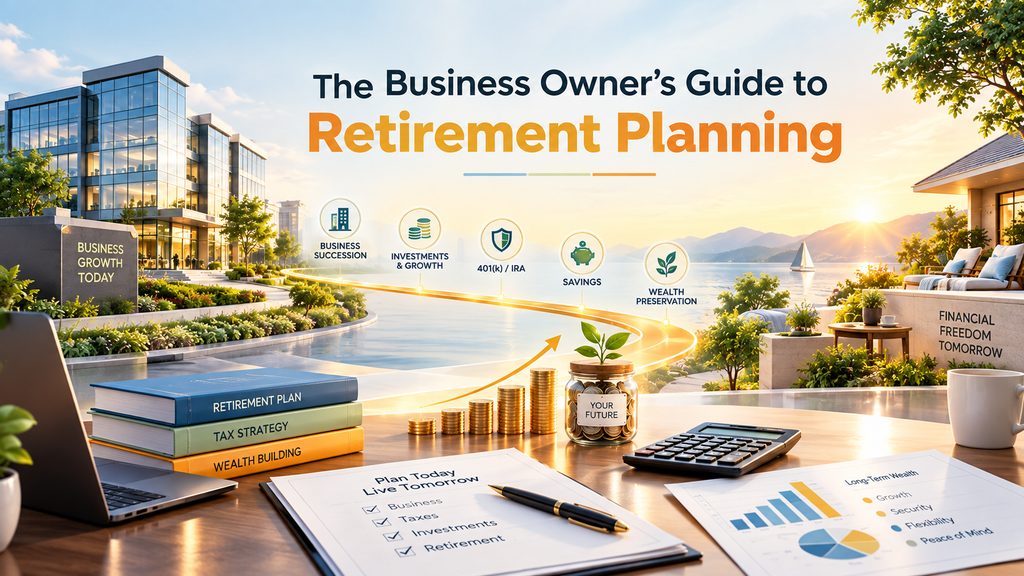
Your business may be your biggest asset—but it should not be your only retirement plan.
As a business owner, it is easy to put retirement planning on the back burner. Payroll, employees, customers, taxes, cash flow, and growth often take priority.
But waiting too long can limit your options.
A well-designed retirement plan can do more than help you save for the future. It can also support tax planning, employee retention, cash-flow management, and long-term wealth building.
The key is choosing a strategy that fits both your business and your personal financial goals.
Start With Your Business
There is no single retirement plan that works for every business owner.
A self-employed consultant with no employees has very different needs from a company with 20 employees. Likewise, a profitable, established business may have opportunities that are not practical for a newer company with unpredictable cash flow.
Before choosing a plan, consider:
- Business structure
- Current and projected income
- Number of employees
- Cash flow
- Current tax situation
- Desired retirement savings
- Long-term business and succession plans
Two business owners with similar incomes can benefit from very different retirement strategies.
The right question is not simply, “Which plan lets me contribute the most?”
It is “Which strategy works best for my business, my taxes, my employees, and my long-term goals?”
IRA: A Simple Starting Point
An Individual Retirement Account (IRA) can be a straightforward way to build retirement savings outside your business.
With a Traditional IRA, contributions may be deductible depending on your income and circumstances. Investment earnings generally grow tax-deferred, and withdrawals are generally taxable.
A Roth IRA works differently. Contributions are made with after-tax dollars, but qualified withdrawals are generally tax-free.
For 2026, the IRA contribution limit is $7,500, with an additional $1,100 catch-up contribution generally available to individuals age 50 and older, subject to applicable rules.
Higher-income taxpayers may also consider a Backdoor Roth IRA. This generally involves making a nondeductible Traditional IRA contribution and then converting it to a Roth IRA.
However, the tax consequences can become more complicated if you already have Traditional, SEP, or SIMPLE IRA balances because of the pro-rata rules.
The takeaway: a Backdoor Roth should be evaluated as part of your overall tax strategy—not treated as a simple transaction.
SEP Plans: A Flexible Option for Smaller Businesses
A Simplified Employee Pension (SEP) can be attractive for small-business owners and self-employed individuals.
For 2026, contributions can generally reach 25% of compensation, subject to applicable rules and limits, with the maximum contribution generally reaching $72,000.
One potential advantage is flexibility. When business income changes, contribution amounts may also change, subject to the plan’s requirements.
But there is an important consideration:
A SEP is not simply an account for the business owner.
When employees meet the applicable eligibility requirements, employer contributions generally must follow the same contribution percentage for eligible employees.
That means employee costs and eligibility should be part of the decision from the beginning.
401(k) Plans: More Options as Your Business Grows
For businesses with employees, a 401(k) plan can provide a broader retirement benefit and more plan-design flexibility.
Employees can contribute through payroll, while employers can choose from various contribution and plan-design options.
For 2026, the employee elective deferral limit is $24,500, with an $8,000 catch-up contribution generally available to participants age 50 and older, subject to applicable rules.
For business owners with no employees other than a spouse, a Solo 401(k) may also be worth considering. It can allow the owner to contribute in both an employee and employer capacity, potentially creating significant retirement savings opportunities.
As a company grows, additional plan designs may become relevant.
For example, a Safe Harbor 401(k) can use required employer contributions and specific plan requirements to help satisfy certain nondiscrimination testing requirements.
The best 401(k) is not necessarily the one with the highest contribution limit. It is the one that fits the way your business actually operates.
When Profit Sharing or a Defined Benefit Plan Makes Sense
Established businesses with strong and predictable cash flow may have additional retirement-planning opportunities.
A profit-sharing arrangement can allow an employer to make additional retirement contributions for employees according to the terms of the plan. It can also help a business owner build retirement assets while providing an additional employee benefit.
For owners with consistently high income and predictable cash flow, a defined benefit plan may deserve consideration.
Unlike a typical defined contribution plan, a defined benefit plan is designed around a predetermined retirement benefit. The employer generally takes on the funding and investment responsibilities associated with providing that benefit.
These plans can potentially support substantial retirement contributions, but they also come with greater administrative and funding requirements.
They are generally better suited to businesses that have the financial stability to make those commitments.
Retirement Planning Is Also Tax Planning
For many business owners, retirement planning and tax planning should go hand in hand.
Depending on the plan and the individual’s circumstances, retirement contributions may:
- Reduce current taxable income
- Build tax-deferred retirement assets
- Create potential tax-free retirement income through Roth strategies
- Provide additional employee benefits
- Support long-term wealth accumulation
But focusing only on this year’s tax bill can be short-sighted.
You also need to consider what happens when the money comes out.
Different retirement accounts can have very different tax treatments for contributions, investment growth, and future withdrawals.
For example:
- One business owner may prioritize reducing current taxable income.
- Another may want to build more Roth assets because of expectations about future taxes.
- Another may prioritize maximizing retirement savings while preparing for a future business sale.
There is no universal answer.
The best strategy considers both today’s tax picture and tomorrow’s financial needs.
Don’t Make Your Business Your Entire Retirement Plan
One of the biggest mistakes business owners make is assuming the business itself will fund retirement.
A successful business may eventually generate significant value through a sale. But relying entirely on that future transaction can expose an owner to business performance, market conditions, valuation changes, and unexpected circumstances.
Building assets outside the business creates another layer of financial security.
Over time, consider how your overall wealth is divided among:
- Business value
- Retirement accounts
- Investment accounts
- Cash reserves
- Real estate and other assets
This diversification can become especially important as you approach retirement or begin planning for business succession.
Know When to Revisit Your Retirement Strategy
Your retirement plan should evolve as your business evolves.
Consider reviewing your strategy when:
- Your business income changes significantly
- You hire your first employees
- Your compensation changes
- You establish or change your business structure
- Your business becomes more profitable
- You begin preparing for a business sale or succession
- Your retirement timeline changes
A plan that worked when your business generated $200,000 may not be the right strategy when the business is generating $1 million in annual revenue.
Your retirement strategy should grow with you.
Build a Retirement Strategy That Fits the Bigger Picture
Retirement planning is not simply about putting away the maximum amount of money.
It is about building a strategy that fits your business, taxes, employees, cash flow, personal wealth, and long-term goals.
Depending on your circumstances, that could mean:
- IRA or Roth IRA
- SEP
- Solo 401(k)
- Traditional 401(k)
- Profit-sharing
- Defined benefit plan
- Or a combination of strategies
The right choice depends on the bigger picture.
At SAI CPA Services, we help business owners evaluate retirement planning as part of a broader tax and wealth strategy. We look beyond the retirement account itself to understand how the strategy fits your business, income, tax position, cash flow, employees, and long-term plans.
Don’t wait until retirement is around the corner.
Review your retirement strategy today and identify opportunities to build more wealth, manage taxes, and prepare for the future.
SAI CPA Services
Your Tax. Your Wealth. Your Legacy.